Mapping GPS Interference in Real Time: A Partnership Between World Monitor and Wingbits
April 27, ‘26

Real-time data on a problem that's getting harder to ignore
On a day in February 2026, GPS jamming disrupted navigation systems aboard more than 1,100 ships in the Middle East Gulf. That same month, EASA and EUROCONTROL published a joint Action Plan calling for better monitoring and data-sharing to combat GPS interference, a problem now affecting more than 1,500 commercial flights every day.
GPS jamming isn't a new phenomenon, but its scale, frequency, and proximity to civilian aviation routes have reached levels the industry has not seen before. The numbers tell their own story:
- Reported jamming events increased 67% since 2023, according to the IATA 2025 Annual Safety Report
- Spoofing, the more serious variant where false GPS signals trick an aircraft's navigation system into believing it's somewhere it isn't, has risen 193% over the same period
- In January 2025, a Ryanair flight en route to Vilnius aborted its landing approach at 850 feet and diverted to Warsaw due to GPS interference
- India's Civil Aviation Ministry reported 1,951 GNSS interference cases between November 2023 and November 2025
- Thirteen EU Member States have since raised formal concerns
This pattern is becoming harder for regulators and airlines to ignore. The ability to detect and visualise what's happening in real time depends on something most people don't think about: the thousands of individuals around the world who voluntarily collect and share aviation data from their rooftops, balconies, and backyards.
From NASDAQ to open-source OSINT
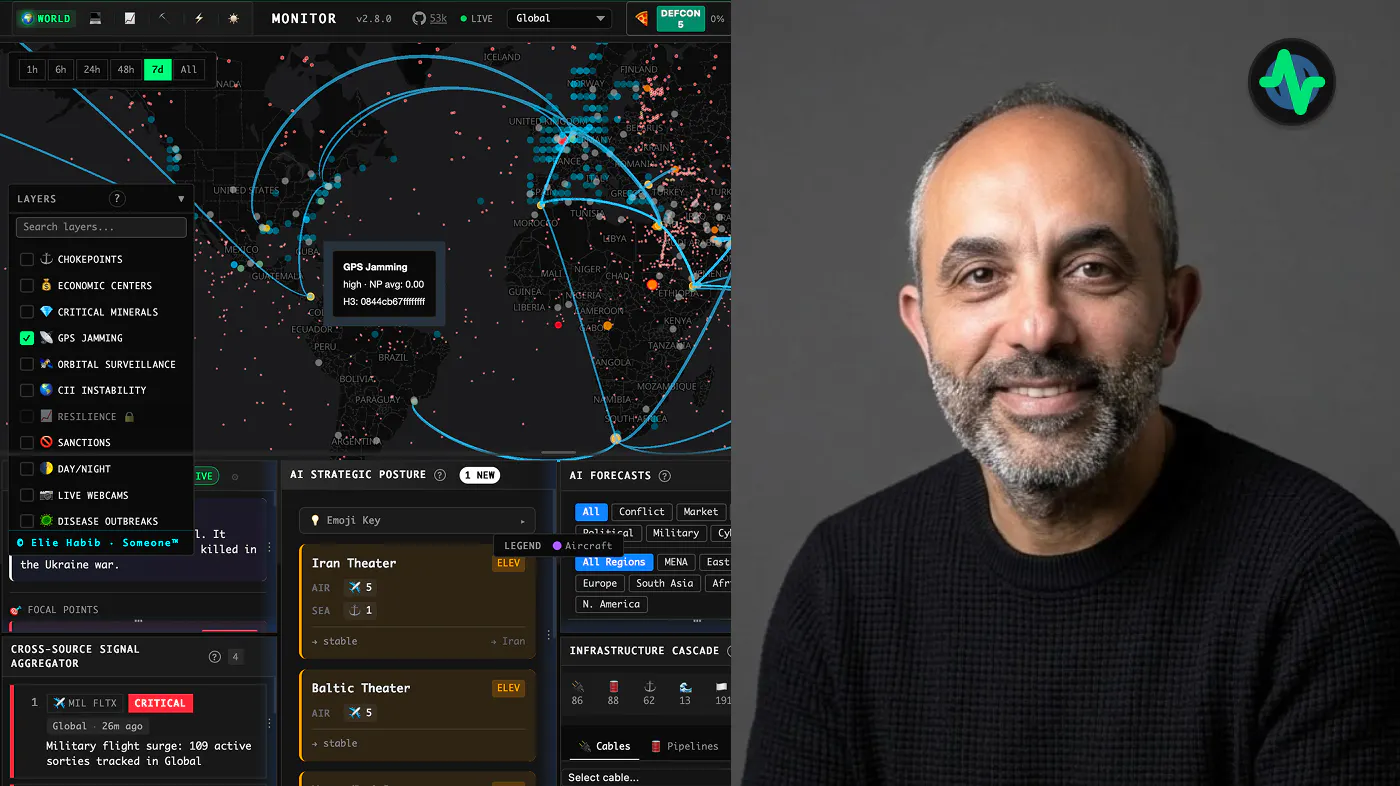
World Monitor came from Elie Habib, the co-founder and CEO of Anghami, the Middle East and North Africa's leading music streaming platform and the first Arab tech company to list on NASDAQ. Habib has spent over a decade building technology products used by tens of millions of people across the region.
World Monitor started as a weekend project, what Habib describes as a vibe-coded experiment. He wanted to build a single interface where anyone could see what was happening in the world: conflicts, military movements, economic disruptions, cyber threats, infrastructure status, all on one map, in real time.
He open-sourced it on GitHub. Within weeks, it had thousands of stars. Within months, it became one of the fastest-growing OSINT projects in the world: 41,000+ GitHub stars, 500,000+ daily unique visitors, 2 million total visits, support for 21 languages, and data aggregated from more than 65 external sources.
The appeal was obvious. In a world where geopolitical information is scattered across dozens of feeds, paywalled behind expensive intelligence platforms, or delayed by hours, World Monitor offered something different: everything in one place, open, free, and updated in real time. But one critical layer was still missing from the picture: aircraft movement.
Why flight data is the most underrated intelligence signal
Military cargo flights surging into a region before headlines break, government aircraft quietly repositioning, and GPS accuracy degrading across an entire airspace are all telltale signs that electronic warfare is active nearby.
Flight data has always been one of the richest open-source intelligence signals available, and the OSINT community has known this for years. Accounts like Intel_Sky, MATA_osint, and AuroraIntel have built large, dedicated audiences by manually tracking military aviation, tail numbers, and airspace anomalies to piece together what's actually happening in the world.
What makes all of it possible, though, is the people who collect the underlying data in the first place.
The invisible contributors
Every flight tracking platform, whether it's FlightRadar24, ADS-B Exchange, or Wingbits, depends on a global network of volunteer contributors. These are individuals who install ADS-B receivers at their homes and feed real-time aircraft surveillance data to the platforms that analysts, journalists, and aviation professionals rely on every day.
It's a remarkable model. Thousands of people in dozens of countries, maintaining hardware on their rooftops, quietly providing the raw data that powers an entire industry.
At Wingbits, we have over 5,500 ADS-B stations worldwide, each operated by a community member using cryptographically secured hardware. Our contributors receive rewards based on the quality and quantity of data their station provides, a model designed to recognise the real value of their contribution rather than treat it as free infrastructure.
What makes this collaboration powerful is the chain it creates: individual contributors feed data to Wingbits. Wingbits processes, enriches, and serves that data through its API. Platforms like World Monitor build on top of it, transforming raw ADS-B signals and GPS accuracy metrics into visual, accessible intelligence that reaches hundreds of thousands of people daily.
What Wingbits provides to World Monitor
For World Monitor, Wingbits delivers two critical data feeds:
- ADS-B flight tracking data: real-time positions of military, government, and civilian aircraft, enriched with aircraft type, callsign, and flight path information. World Monitor uses this to automatically identify and display military aircraft movements across its global map, covering 220+ military bases and live flight paths.
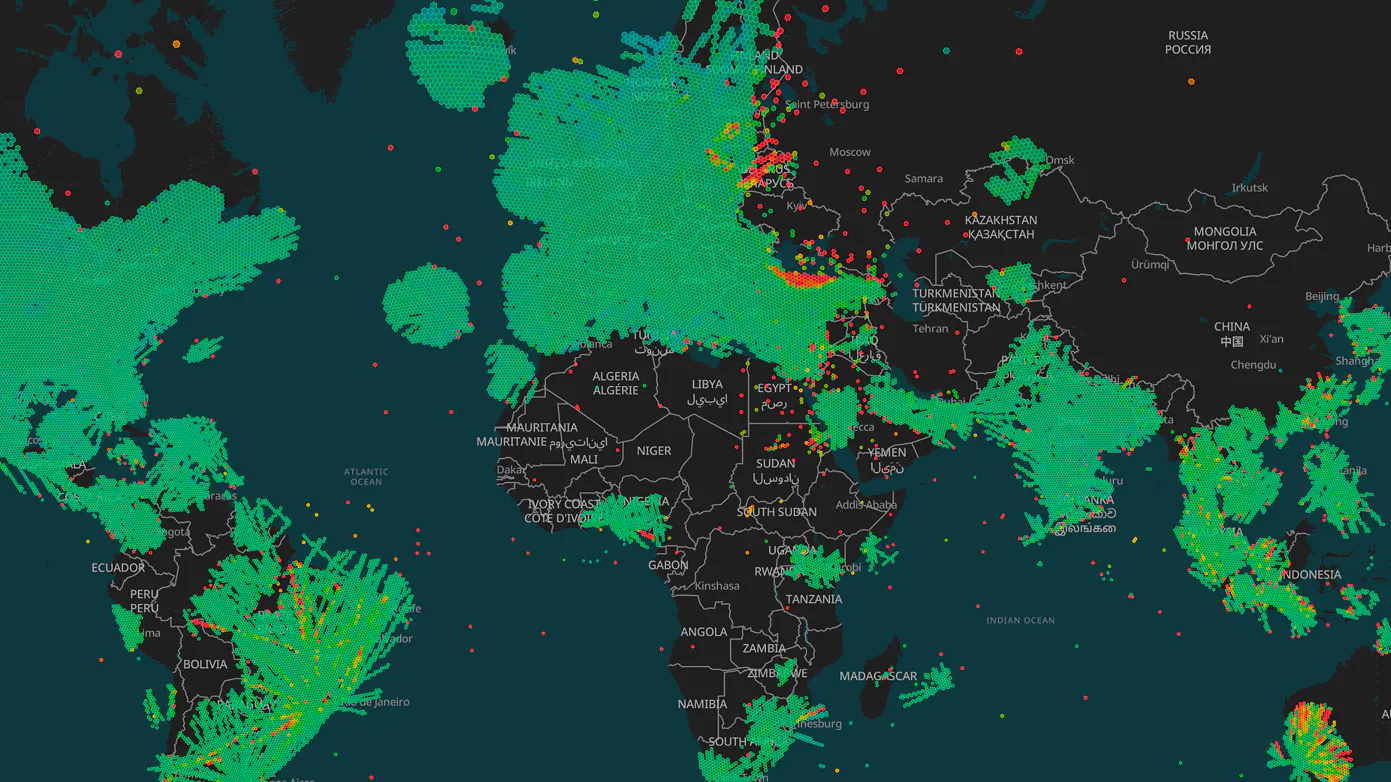
- NACp (Navigation Accuracy Category for Position) feed: this is the GPS accuracy metric that reveals where interference is happening. When an aircraft's reported GPS accuracy degrades, it shows up in the NACp data. Aggregated across thousands of aircraft in a region, this creates a real-time heat map of GPS jamming and spoofing activity, the exact capability that regulators are now calling the industry to build.
What this looks like in practice
Open World Monitor today and navigate to the Eastern Mediterranean, Black Sea, or Persian Gulf. You'll see aircraft positions updating in real time, colour-coded by type: military, government, cargo, civilian. Beneath that layer, the GPS interference overlay shows where NACp values are degrading, visualised as hotspots that shift and intensify as electronic warfare activity changes.
This is the kind of data that intelligence analysts at firms like Bellingcat and Jane's would use. The kind of data that aviation safety teams at airlines need to make routing decisions. The kind of data that journalists at Reuters, BBC Verify, and The Economist reference to verify geopolitical events. No login, no paywall required.
And it's already generating real commercial interest for the data behind it. Enterprise leads critical event management to risk analytics platforms have found Wingbits directly through World Monitor, drawn by seeing the data in action. When the data is visible and useful, it tends to find its own audience. Open visibility creates qualified demand.
Why collaboration matters more than any single platform
The story of World Monitor and Wingbits isn't really about two companies partnering. It's about what happens when the OSINT community, data contributors, and data providers all pull in the same direction.
The global OSINT market reached $5.17 billion in 2025 and is projected to grow at 5.85% CAGR through 2034. The consumers of this intelligence aren't just government agencies. They include risk analysts, journalists, prediction market traders, insurance underwriters, academic researchers, and aviation professionals. They need data that's fast, verifiable, and accessible.
Meeting that demand requires collaboration across the entire chain. Contributors need to be recognised and rewarded for the data they provide. Data providers need to make their feeds accessible to builders, not just enterprise buyers. OSINT platforms need to take raw data and turn it into something the world can actually use.
When that chain works, a station operator in Germany, a data API in Malta, and a dashboard built by the CEO of a NASDAQ-listed company in Lebanon can collectively deliver real-time GPS interference intelligence to 500,000 people a day.
World Monitor is proof that open-source tools and community-contributed data can produce something that outperforms most commercial intelligence products on reach and accessibility. That's worth paying attention to as this industry matures.
What comes next
The partnership between Wingbits and World Monitor is still in early stages, and there's more to build:
- MLAT (multilateration) for enhanced military tracking
- AIS integration for maritime intelligence
- Deeper analytics layers
- Expanded coverage in the regions where geopolitical monitoring matters most
But the foundation is set, the data is live, and the users are there. Most importantly, the contributors who make it all possible are growing every day.
For developers, researchers, and organisations who want to build on the same data: the Wingbits API is available at wingbits.com/dashboard/developers.
For station operators and contributors: this is what your data makes possible. Every signal your receiver picks up feeds into a chain that reaches analysts, journalists, and decision-makers around the world. That matters.
Explore World Monitor: worldmonitor.app
Build on Wingbits data: https://wingbits.com/
Join the Wingbits network: wingbits.com/stations
- Aireon. "Observations of Trends in GPS Anomalies Affecting Aviation." White paper.
- Allianz Commercial. GPS interference risk assessment.
- Anghami / Elie Habib. First Arab tech company listed on NASDAQ, 2022.
- CNN. "Ships and planes are vulnerable to GPS jamming. The Iran war is revealing just how bad the problem is." March 2026.
- EASA & EUROCONTROL. Joint Action Plan on GNSS Interference. March 2026.
- IATA. Safety Report: GPS jamming events up 67%, spoofing up 193% since 2023. March 2026.
- India Civil Aviation Ministry. 1,951 GNSS interference cases reported, November 2023 to November 2025.
- Stats Market Research. Global OSINT market valued at $5.17B in 2025, projected 11.8% CAGR to 2034.
- World Monitor. Military tracking documentation. worldmonitor.app/docs/military-tracking